
Beauty retail in APAC: One in-store challenge, many executions
March 11, 2026
Asia Pacific is driving the future of beauty retail. The region accounted for nearly 40% of global beauty and personal care market value in 2024, making it the largest single regional share worldwide.
While that growth presents enormous opportunity, it also introduces significant complexity in retail execution. The APAC region is not a single, unified retail environment. It is a collection of markets with vastly different shopper behaviors, operational constraints, and infrastructure readiness.
Consumers are also not uniformly spending less or consistently trading up. Instead, spending behavior varies widely by category and by market. In growth markets like India, where 58% have increased their purchase frequency in the past year, premium brands can reach a broader consumer profile. Meanwhile other cultures might prioritize “recession glam” affordability a trend driven by consumers preferring small luxuries driven by economic constraints. This shift is reinforced by growing global value skepticism: 24% of consumers say they have traded down to cheaper beauty products in the past 12 months, highlighting the move to affordable indulgence.
As beauty brands expand across APAC, they encounter a region defined by contrast. In some markets, shoppers research ingredients online, scan QR codes in-store, and expect seamless omnichannel fulfilment. In others, conversion still depends on physical testing, promoter guidance, and visible, premium, value at shelf. What drives a skincare or cosmetics launch in one market may underperform in another.
The new reality for beauty retail
As online shopping is increases in popularity, with ecommerce sales projected to account for around a third of beauty sales by 2030, the pressure on in-store touchpoints, especially in beauty stores, is higher than ever. They must explain product value, reinforce brand credibility, and connect seamlessly with what shoppers have already seen online.
While shoppers often arrive with prior awareness shaped by social media, influencers, and online research, once that consumer walks into a store, the final decision still depends on how seamlessly the in-store experience is. Can the product be understood quickly? Does the display build confidence? Does the experience reinforce what the shopper already believes about the brand?
The shared challenge: scaling relevance across very different markets
These expectations create a challenge that many global beauty brands now face: how do you design an in-store touchpoint that engages shoppers, communicates value, and can scale across multiple markets?
To see how this challenge unfolds across APAC, we asked SMEs from across the region to share what they’re seeing on the ground.
The question was the same:
How would you, in your market, introduce a beauty store touchpoint that:
Engages shoppers meaningfully
Communicates product value clearly
Works across both digitally advanced and more traditional retail environments
Scales efficiently across multiple markets
Considers sustainability in its design and execution
Here’s how our in-market experts approached the brief.
In India, cultural fluency matters more than pure technology
When it comes to India, winning in-store beauty retail is less about adding more technology and more about designing experiences that balance innovation with cultural fluency.
“To succeed in India’s beauty retail market while scaling across APAC, in-store touchpoints must blend digital innovation with cultural sensitivity, prioritize storytelling over static displays, and embed sustainability into design.”
Makarand Awate, Strategic Sourcing Manager, Tag India
Shoppers in the region respond to experiences that reflect familiar, everyday beauty rituals, ingredients and formats, whether that is Ayurveda-led narratives, live demonstrations, or advisor-led consultations. Sustainable practices like refill stations, recyclable materials and energy-efficient fixtures are also moving from ‘nice-to-have’ to expected.
Makarand also emphasizes that brands have to design for reality, not ideal conditions. Connectivity can be patchy. Power isn’t always reliable. And shopper expectations shift dramatically from one city or store format to the next.
Flexibility, therefore, becomes essential. The most effective beauty stores don’t choose between physical or digital. They combine both, creating hybrid touchpoints that work wherever the customer is. In this context, the most future-ready stores are not the most high-tech, but the most adaptable: designed to flex across markets while delivering consistent, culturally relevant experiences.
Friction is the real enemy for Singapore
Singapore presents a very different retail challenge. According to Wan Shin Tan, Business Director, APAC, shoppers in the region are mobile-first, QR-native, and highly exposed to global retail standards. They are efficiency-driven, time-sensitive, and sustainability-aware, but ultimately led by convenience.
“Singaporean shoppers do not need education on how to scan a QR code. They need a reason to do it. That means in-store touchpoints must deliver value within seconds or risk immediate drop-off.”
Wan Shin Tan, Business Director, APAC
This urgency is reinforced by the retail environment itself. High rental pressure, strict compliance and planogram discipline, limited manpower, and minimal back-of-house storage leave little room for experimentation. In this market, operational friction kills ideas faster than creative weakness.
As a result, the guiding question for any in-store intervention becomes simple:Does this reduce friction, increase confidence, convert faster, and justify the space and materials it occupies?
Effective shopper marketing for beauty retail in Singapore tends to share three traits:
1. Clean, premium aesthetics that spotlight hero SKUs, shades, and ingredient claims.
2. Modular beauty fixtures that flex across locations, counters, gondolas, and end caps.
3. Reusable launch kits for seasonal beauty drops
In this market sustainability takes on a more pragmatic form. Beauty brands succeed when responsibility is built into the system: fixtures designed for repeat launches, materials chosen for durability and recyclability, and aesthetics that remain refined across cycles. Performative sustainability is easy to spot and easy to dismiss.
Australia: The webrooming capital of the world
Virginie Muti, Group Account Director, introduces a different idea, one she notes Australian shoppers have mastered: webrooming, the process of researching products before purchasing them in-store.
“Australian shoppers are world leaders in “webrooming” with 78% researching online before heading in-store to buy. Your in-store experience needs to mirror what they’ve already seen on Instagram or TikTok, so products are instantly recognizable.”
Virginie Muti, Group Account Director, Tag ANZ
Because shoppers arrive informed, displays don’t need to educate from scratch. Instead, they should prioritize trial and ingredient credibility. High-performance, science-backed actives such as retinol or Vitamin C serve as proof points, shifting the shelf’s role from explanation to validation.
This behavior also makes shopping more self-directed. With educated, independent shoppers and rising labor costs, clear signage, intuitive layouts and self-serve touchpoints become essential. Sensory displays that allow shoppers to touch, smell and test products help drive decisions without heavy staff reliance.
Sustainability is also part of that pre-store research. As of 2024, close to 50% of Australian shoppers now actively consider sustainability when shopping, with 42% even willing to pay more if that guarantees sustainable or eco-friendly purchases. If your beauty display looks like “single-use trash”, the brand suffers.
In Malaysia, simplicity is king
In Malaysia, shoppers are increasingly hybrid with 85% of them switching between online and offline channels, sometimes in the same purchase journey. So, stores need to be able to capture customer attention, fast.
Rachel Tan, Strategic Sourcing Director, SEA, stresses the fast-paced nature of shopping in the region.
“Since in-store shoppers are usually in a hurry and tend to scan shelves quickly, they respond better to clear messaging, strong visuals, and tangible offers.”
Rachel Tan, Strategic Sourcing Director, SEA
So instead of heavy copy like this:
Formulated with a proprietary blend of dermatologically tested active ingredients, this advanced brightening serum works to visibly reduce pigmentation, improve skin tone, and support long-term skin health with continued use.
A simple headline + price/benefit structure works better:
Brightening serum, visibly evens skin tone in 14 days - RM129
The same need for clarity applies to sustainability. While 91% of Malaysians say they are open to buying sustainable products, most are only willing to pay less than 10% more, and 32.4% remain unsure whether eco-friendly labels are genuine. Environmental claims must be specific, visible, and easy to verify at shelf level, otherwise they are filtered out just as quickly as dense copy.
Operational realities reinforce this need for simplicity. Store teams typically have limited time to install, update or maintain displays, while floor space is shared across multiple brands. Flexibility becomes essential. Displays that are lightweight, modular and easy to assemble are far more practical than complex, permanent fixtures. Flat-pack units or interchangeable panels allow brands to refresh messaging quickly without disrupting store operations or relying heavily on staff support.
Infrastructure also varies widely across retail environments. Store size, power availability and fixture standards are inconsistent, and not every location can support digital screens or heavy installations. Logistics and back-of-house storage space can be equally constrained. In these conditions, low-dependency solutions work best, such as printed panels in place of lightboxes where power is unavailable.
For beauty brands in Malaysia, effectiveness often comes down to designing displays that respect speed, space and operational limits, while still delivering a clear, compelling message at the shelf.
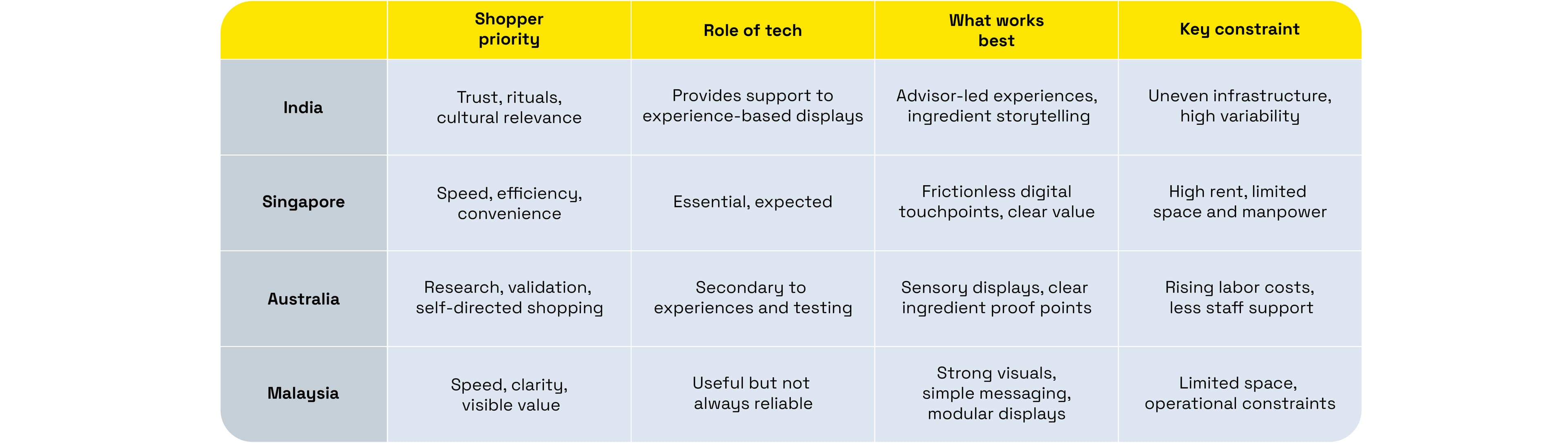
APAC geographies, key differences
No one-size-fits-all approach
Across APAC, the challenge is not defining what an effective in-store touchpoint should do. That brief is largely consistent: engage shoppers, communicate value clearly, and convert efficiently. The challenge lies in how that brief must adapt to local realities.
Each market brings its own expectations, constraints, and operational conditions. In some, speed and efficiency determine success. In others, cultural relevance, sensory validation, or simplicity matter more. What emerges is a clear pattern: the most effective in-store executions are not the most standardized, but the most adaptable.
For beauty brands, scaling across APAC no longer means replicating the same execution everywhere. It means building flexible systems that deliver consistent outcomes while responding to local context. Because in a region defined by diversity, adaptability is what makes scale possible.
Loading...