
Always-On Expectations: Why Delivery Capability Is the New Retention Advantage
July 20, 2026
The continuity gap
A purchase no longer marks the end of a customer journey. It now marks the opportunity to create a stronger relationship. Buyers want every interaction that follows, whether it's delivery updates, product support, or loyalty communications, to feel connected as part of the one continuous brand. In fact, 76% of consumers now look for this kind of unified experience, regardless of how or where they engage.
In APAC markets, where people routinely move between apps, websites, messaging platforms, and physical locations, continuity has become a baseline expectation rather than a competitive differentiator.
Yet despite these rising standards, many organizations are still structured around campaign cycles rather than ongoing engagement. Buyers simply don’t care about internal calendars or handoffs. They notice only when the experience feels fragmented. Every delay or disconnect between these two realities adds another point of friction, putting loyalty at risk.
This third part of our Digital Experience Series, explores why delivery capability has become one of the biggest competitive differentiators in online journeys, and why organizations built for campaign execution are increasingly struggling to meet always-on customer expectations.
Why campaign-era operating models are becoming the retention constraint
The benchmark for customer experience (CX) isn’t set by your competitors anymore. Services like next-day retail delivery, instant streaming, and ride-hailing apps are resetting what great service feels like. In APAC, this shift is especially visible. 82% of service professionals report that users now demand issues be resolved within three hours. Brands are increasingly judged by their real-time agility throughout the service journey.
The problem isn't that organizations are unaware of these standards. The challenge is that many still aren't structured to respond quickly enough. As a result, retention happens, not over one big mistake. Clients gradually disengage as small, frustrating moments add up, eventually making the relationship feel too burdensome to maintain.
Rigid calendars and fixed campaign cycles create friction, causing loyal customers to drift away. Yes, content is easier to make than ever, but timing is what actually counts. Market leaders are those who can move fast and deliver what users need, exactly when they need it. As content creation becomes commoditized, a company's value increasingly depends on its distribution- agility.
Spotify offers a good example. This platform updates recommendations, playlists, notifications, and tailoring content as listening habits change. The underlying delivery infrastructure stays completely invisible; users simply experience effortless personalization. That’s what users now expect from every enterprise they choose to buy from, including yours.
Numbers already point in the same direction. Companies excelling in CX have achieved more than double the revenue growth of those lagging behind. Operational responsiveness is fueling both user satisfaction and long-term results.
Why responsiveness now determines commercial performance
Responding continuously doesn't mean creating more content. It means making existing content easier to adapt, reuse, and deploy. That's where mature content supply chains create commercial value.
A modern content supply chain is essential for this. Instead of continually hiring and briefing more creative staff, leading brands are investing in component libraries and templates that can be rapidly customized and deployed across markets. As a result, companies with advanced resource chains report 30% higher asset reuse, 40% fewer production hours, and 70% faster time-to-market.
The real advantage comes from making it easier to adapt quickly when circumstances change, rather than simply increasing asset production. Traditional teams respond to demand by stacking up approvals and admin. High-velocity brands built for flexibility and rapid iteration, keep costs flat as they expand their footprint and relevance.
Why operating models now matter more than technology
Technology often gets blamed for slow CX. Most delays in reality originate in legacy processes and structures. Even the best platforms can’t compensate for workflows designed for last-decade media launches.
This fragmentation shows up in how teams are measured and managed. Creative, engineering, data, and regional groups often operate with separate goals, one focused on asset production, another on platform delivery, another on reporting. Buyers never see those boundaries; they only notice whether the experience worked.
As customer needs evolve and expectations for seamless, immediate service continue to rise, the cracks in these fragmented systems become more visible than ever. Every extra handoff, manual approval, or regional sign-off adds risk and cost, and makes it less likely your brand will be there at the moment that matters. It requires a business framework built for continuous delivery.
Shifting metrics from asset output to delivery velocity
When leadership focuses entirely on production output, they miss the reality that users judge them based on their prompt responsiveness. The real shift is moving from output metrics to velocity metrics across the digital ecosystem.
Shifting from fragmented campaign execution to high-velocity delivery infrastructure
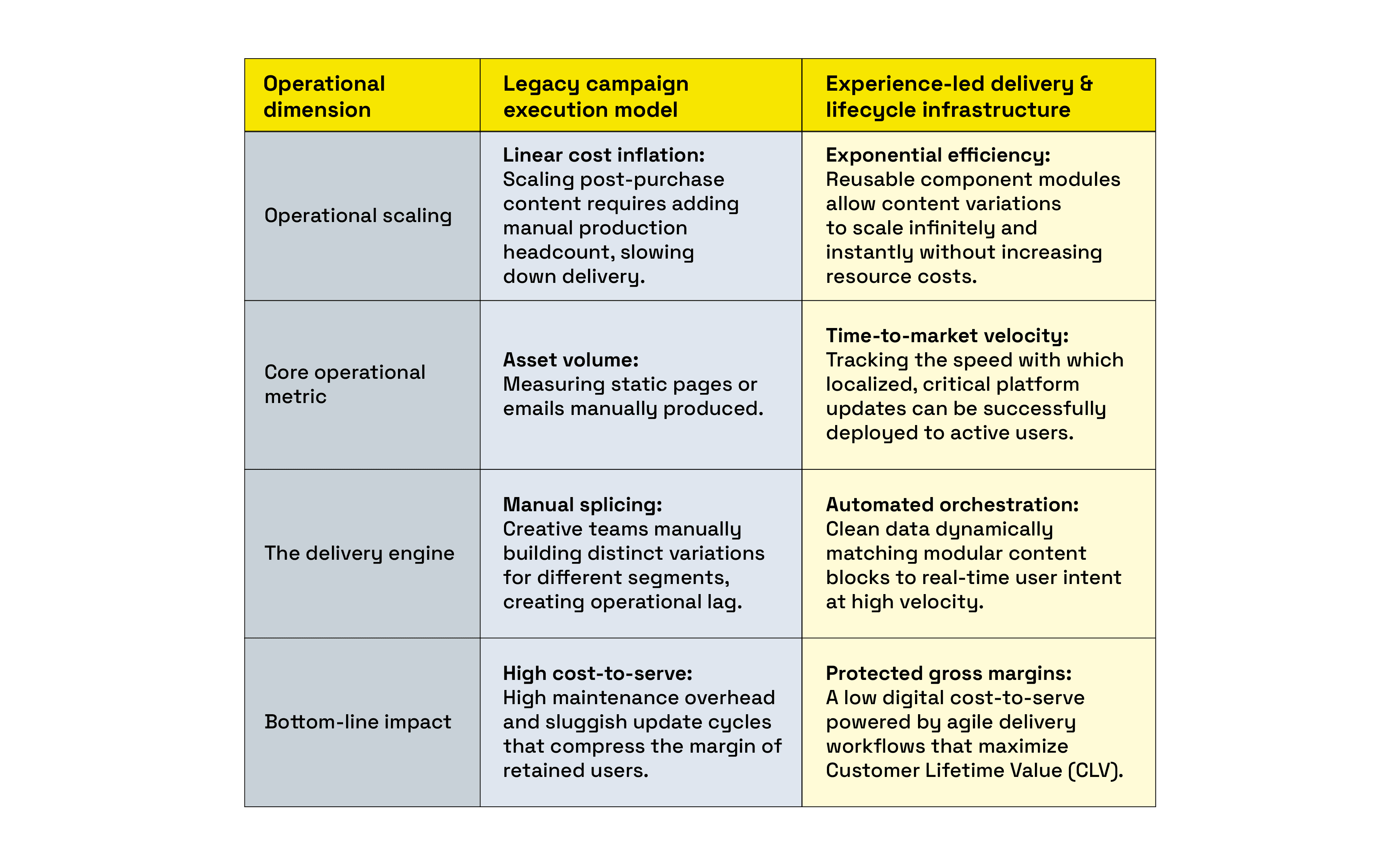
When creative, engineering, and data teams align around delivery velocity, organizations gain the flexibility to meet always-on customer expectations while protecting profitability.
The retention question leaders should be asking
Success today means more than just having the flashiest campaigns or the largest content libraries. The real winners are those who have reimagined their teams and workflows to keep pace with evolving client needs, delivering value at every touchpoint.
Retention is decided in the small interactions between campaigns, at the intersection of technology, process, and human insight. Brands that keep working in bursts rather than building for always-on delivery, will continue to lose ground, even if their ideas are strong. The next age of growth belongs to organizations that see operational responsiveness as a permanent asset.
Upgrading technology is only part of the solution. Leadership must rethink how the organization operates and starts building the muscle for continuous delivery. Your audience are already living in a continuous digital world. The only question is whether your business is built to meet them there and whether it can sustain that delivery over time.
Loading...