
Designing for First Click: Why Breaking Silos Is the Key to Stronger Digital Awareness
June 4, 2026
Competing for the first click
From paid media and search journeys to ecommerce experiences and mobile interactions, digital awareness is shaped across multiple touchpoints, often within the same session. In this saturated market of digital experiences, capturing that attention is getting tougher day by day. Consumers decide whether to engage within two to five seconds, often before a message has the chance to fully land, raising the bar for clarity and relevance at first touch.
Within the digital experience lifecycle, the customer journey spans multiple stages: from awareness and consideration through purchase and retention, and ultimately into loyalty and advocacy. Ensuring the digital experience is designed for first click is critical at the awareness stage, where first impressions are formed and where many digital interactions succeed or fail before they fully begin.
For brands competing in APAC markets, the awareness stage has become a pressure point. Every interaction, be it a landing page, a homepage module, or a paid media clickthrough, carries weight. Every delay, disconnect, or generic experience creates friction that users rarely recover from.
At this moment, the challenge isn't a lack of innovation. Even as many organizations begin to leverage capabilities like AI-driven personalization, predictive search, real-time journey optimization, and automation tools, the real challenge is creating digital experiences that feel connected across touchpoints. Too often, innovation becomes a late-stage add-on, layered over design choices and technical constraints that were set too early. The obstacle isn’t access to technology. It’s how those capabilities are applied and whether digital, engineering, and data teams are collaborating from the very start to shape digital experiences around authentic customer behavior.
The most effective awareness-stage digital experiences come from early, integrated teamwork. When creative, data, and delivery experts align upfront, it’s easier to orchestrate intentional, relevant, and consistent journeys across web, mobile, social, and more.
Democratized production demands elevated strategic design
Automation and AI have made digital execution faster and more accessible. Tasks like generating layouts, adapting content formats, tagging assets, and even assembling page components can now happen at scale. What hasn’t changed and has, in many ways, become more critical is human judgment.
Access to AI tools has expanded rapidly, yet only a third (36%) of organizations have fundamentally rethought how decisions are made. This creates a gap: while production accelerates, experience quality doesn’t always follow. At the awareness stage, this becomes visible immediately. A personalized homepage, a dynamically generated landing page, or an adaptive content flow may technically function, but if the structure, priority, and message clarity are misaligned, the experience still fails to engage.
Hence, speed is no longer the differentiator but the ability to make better experience decisions earlier. Such as, how a page is structured, which message appears first, how content adapts based on context, and how clarity is delivered within seconds. What resonates, more so than automating the mechanics, is a digital experience orchestrated with clear intent, where technology and AI capabilities support the narrative rather than define it.
What’s breaking innovation: siloed ways of working
Digital fragmentation remains the enemy of great awareness experiences. Not every brand has a fully mature tech stack, but across the industry, digital journeys too often feel disconnected. The primary friction sits between teams and disciplines, where designers create interfaces without platform insight; engineers are brought in after the fact, and data analysts validate results post-launch.
Fragmented data environments and disconnected workflows remain the most persistent barriers to real-time digital personalization. The results are inconsistent personalization, reactive optimization, and awareness-stage experiences that lose their spark before they reach the customer.
This fragmentation is especially costly at the awareness stage, where consumers rarely wait for a brand to improve a broken journey later. By replacing sequential handovers with a shared discovery phase, real-time behavioral signals can be designed into the platform architecture from day one.
Shifting from linear siloes to a connected experience model
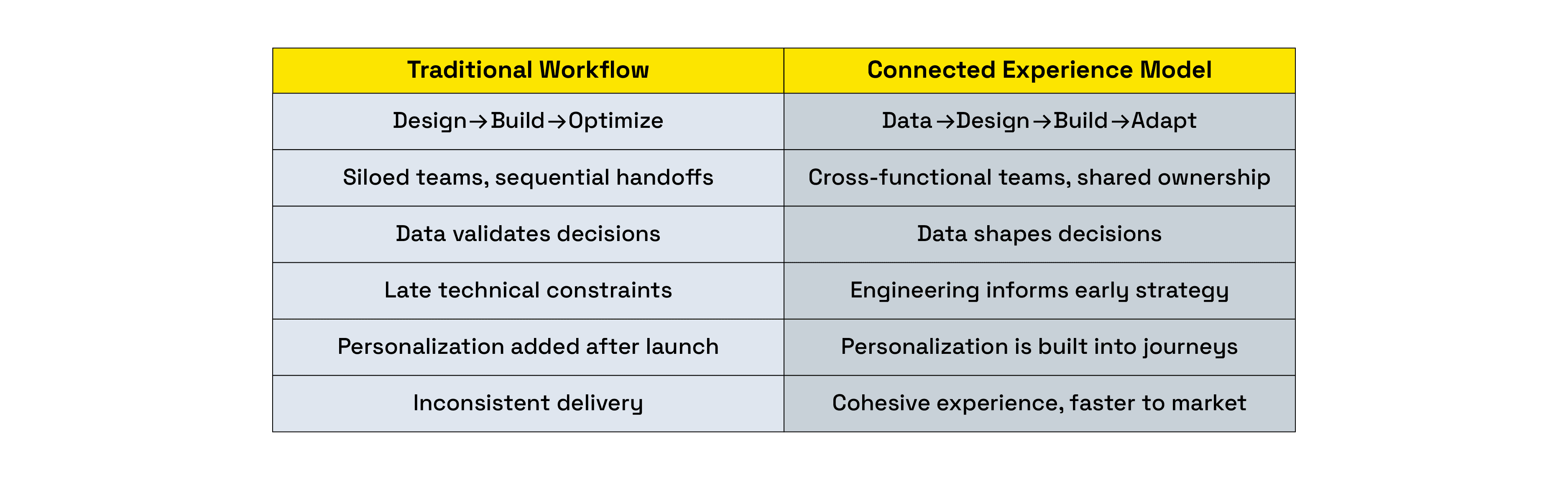
This connected model changes how digital experiences scale. When decisions around UX structure, content delivery, personalization logic, engineering feasibility, and channel behavior are made together, teams reduce rework, avoid late-stage compromises, and deliver more consistent experiences across websites, mobile platforms, ecommerce journeys, and campaign ecosystems. That’s what enables scalable global delivery without sacrificing relevance.
Use data as a creative catalyst
Data is often treated as a retrospective tool. But at the awareness stage, its value is highest when used upfront. Behavioral signals such as search intent, click patterns, drop-off points, and platform usage offer direction before experiences go live. They help shape what appears first on a homepage, how a landing page is structured, and which message surfaces for a given audience segment.
This shifts data from measurement to input. When applied early, data influences:
Content hierarchy on landing pages
Navigation priorities
Personalization logic across channels
Message sequencing in first interactions
The results are better optimization and stronger starting points. This is how digital leaders move from reactive optimization to experiences designed to perform and resonate, from the very first click.
Acceleration without direction creates repetitions & sameness
AI has fundamentally changed the velocity of digital production. Teams can now generate content variations, dynamic page components, and personalized touchpoints at a scale that was previously unattainable.
However, speed is a dangerous metric when detached from intent. Without a strong digital strategy, AI-driven automation can amplify sameness, producing hundreds of landing pages or email variants that lack a coherent brand identity.
At the awareness stage, where attention is fragile, this creates noise instead of impact. Success here depends on distinction, relevance, clarity, and timing. If an AI engine produces a thousand landing page variations that all lack a coherent brand identity, the consumer perceives it as digital noise. This is reflected in the widening performance gap across the industry: while market leaders in personalization are achieving growth rates 10% higher than their competitors, only 10% of companies currently manage to deliver that personalization effectively at scale. Generating content is no longer the challenge; it’s orchestrating it with enough strategic intent to make it meaningful.
Designers are essential curators of meaning. Their role is to set the intent and emotional clarity that AI cannot. By defining the context and relevance of a campaign before the first prompt is written, teams ensure AI becomes a high-velocity engine for digital storytelling instead of a content machine.
Designing for the first click
Building a strong first impression is the outcome of early alignment. By the time a user lands on a page, most of the decisions shaping that experience have already been made: how quickly the page loads, how content is prioritized, how personalization behaves, and how clearly the message is communicated. At the awareness stage, these decisions determine whether a user engages or exits.
The shift underway is from reactive optimization toward intentional design. When creativity, production, data, and technology operate as a connected system, experiences feel more cohesive, responsive, and aligned across channels.
For leaders focused on improving awareness-stage performance, the path forward lies in breaking the silos that prevent technology, creativity, and customer insight from working together. Because in the end, the first click is not just a moment. It is the result of every decision made before it.
Loading...