What's next for omnichannel? Unlocking optichannel with hyperautomation
May 13, 2026
These days, the brands that aim for omnichannel may already know which channels to prioritize, which audiences to reach, and what experiences they want to deliver. But as touchpoints multiply, so does the pressure to produce more content, faster, and with greater consistency. Brands quickly find that the real friction begins when campaign and content strategies move into production.
Content must be adapted across formats, localized across markets, and deployed continuously. At the same time, the inputs driving the brand content, including media plans, platform algorithms, and audience signals, are constantly shifting, often in real time. As algorithms increasingly shape what gets seen and prioritized, content needs to adapt faster and more precisely than most production systems allow. A single campaign can quickly expand into hundreds or thousands of assets across ecommerce, marketplaces, social platforms, retail media, and in-store environments.
But these assets are rarely built as part of systems. Every new channel and customer data point adds a layer of complexity. Even with basic automation in place, there is significant effort required to deliver a data-drive, personalized content strategy.
This pressure shows up in predictable ways. Content bottlenecks delay launches. Localization becomes manual and resource intensive. Consistency is expected, but assets are fragmented across teams and markets. Meanwhile, content appetites and channel streams continue to demand more than content can adapt, and teams shift from building systems to managing exceptions.
So how do brands keep up in these rapid content cycles? Hyperautomation provides an opportunity for brands to systemize content automation. More than that, it has the power to elevate omnichannel from scaled to strategic, unlocking an optichannel solution.
Why regular automation is not enough
In an omnichannel world, the underlying complexity is that execution is continuous content cycle, rather than campaign based. When it comes to this increasing content volume, basic automation can help to reduce the repetitive tasks needed to scale assets across multiple formats. But basic automation does not address systemic gaps, leaving teams to manage pressure instead of building systems that can absorb it.
The most successful omnichannel strategies are designed to deliver seamless, personalized journeys. But without connected operations behind them, execution quickly becomes fragmented.
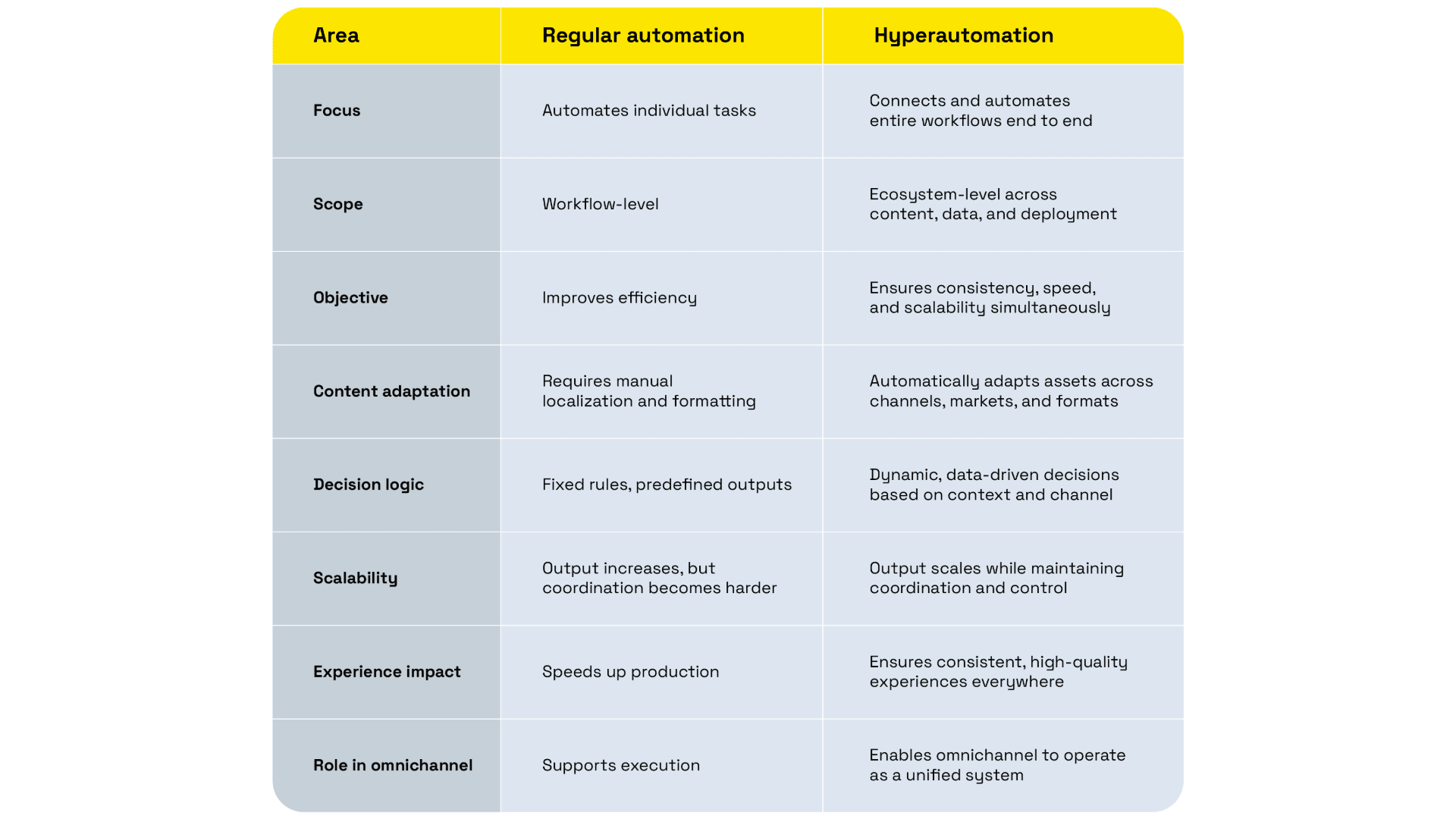
When brands try to close the gap between strategy and execution with more automation, they are misunderstanding that automating tasks is not the same as connecting systems. Task-level automation speeds up individual steps, like asset creation, approvals, or publishing, but those steps still happen in isolation. Content, data, and workflows continue to move separately, which means teams are still responsible for stitching everything together at the point of execution.
In contrast, hyperautomation closes that gap by connecting content, data, workflows, and decision-making into a single system, so execution can scale without falling apart. Hyperautomation is helping brands make omnichannel execution work at scale by connecting and automating entire end-to-end workflows. Data-driven decision making allows the automation to happen semi-autonomously, delivering dynamic adaptation at scale whilst creatives act as the brand guardians. With hyperautomation, continuous content is addressed through a proactive automation system.
From omnichannel to optichannel
Hyperautomation’s real impact goes beyond efficiency. As systems become more connected and responsive, the focus is starting to shift. It is no longer just about being present across channels, but about delivering the most relevant experience based on context, timing, and intent.
Not every channel needs to be activated at once. Not every message needs to be everywhere. What matters is how well brands can respond to what the customer needs in that moment, and how quickly they can align content, data, and execution to support it.
This is where the next phase is taking shape. Many are beginning to define this shift as optichannel, the approach of using the most optimal channel to interact with customers. Content still needs to be created rapidly, but the delivery on the content is more strategic and personalized. Dynamic data plays a critical role in the optichannel journey. Insights inform the precise channels that a brand should be focusing their content on, whilst dynamic data allows for real-time updates to deliver optimal journeys for individual customers.
Hyperautomation is what makes optichannel execution possible. Without a system in place, automation updates would not be fast enough to deliver a truly optichannel journey. By connecting workflows, content, and data into a single system, it allows brands to move from broad, channel-led campaigns to experiences shaped by context, timing, and intent.
3 essential elements of the hyperautomation strategy
Activating an optichannel strategy with hyperautomation requires three key components.
1: Map workflows
It’s risky for brands to operate without a clear view of how work and data actually move across channels. Mapping the full omnichannel journey, including ecommerce, mobile, CRM, brings that visibility. This is where the real gaps surface, including manual handoffs, delayed approvals, and inconsistencies between systems that are not visible at a channel level.
2: Build content to scale across channels
Once workflows are mapped, hyperautomation then shifts to how content is created and deployed within those workflows. Here, content becomes part of the workflow, not something created separately for each campaign.
Behind the scenes, content systems like DAMs and CMSs are connected to workflow tools and live data. That means product visuals, copy, pricing, and offers aren’t scattered across decks and folders, they’re stored centrally and tagged so the system knows where and how to use them.
When something changes, like a campaign going live or a price update, the system kicks in. So instead of teams resizing banners, rewriting copy, or chasing updates across platforms, the system does the heavy lifting. Content is assembled and pushed out in the right format, at the right time, without the usual back-and-forth.
3: Connect customer data
The final step is connecting data like customer profiles, rewards, and purchase history across systems so context can follow shoppers from online browsing to app engagement to in-store checkout.
With regular automation, this data is synced and made visible across channels, often requiring teams to manually act on it. With hyperautomation, that same data becomes active within the workflow.
The impact
By connecting workflows, data, and systems through hyperautomation, brands can finally close the gap between omnichannel strategy and execution, delivering a targeted and personalized optichannel content journey. Campaigns can launch simultaneously across ecommerce, mobile, and in-store channels while loyalty recognition, pricing, promotions and inventory will work consistently across app, web, and physical checkout. And with manual coordination and reporting significantly reducing, customers will experience a smoother, more consistent journey end to end.
Looking ahead, businesses can apply hyperautomation across their operations to drive greater efficiency and control. This includes automating compliance checks, enabling dynamic assortment optimization, managing predictive markdowns, integrating supplier workflows, and orchestrating in-store tasks, all within a connected, intelligent system.
The future of retail success
Success is no longer defined by how many channels a brand can activate, but by how well those channels work together in the moments that matter.
As channels expand and conditions continue to shift, scale alone will not be enough. What will matter is whether organizations can operate in sync across pricing, promotions, inventory, content, and customer data, so that updates reflect consistently, campaigns launch in unison, and customer context moves seamlessly from one touchpoint to the next.
Omnichannel set the expectation for connected experiences. Optichannel raises the bar for how those experiences are delivered. Hyperautomation is the operational backbone that makes both possible at scale.
Loading...